
At precisely the moment commercial spaceflight is exploding, the FAA wants authority to waive major environmental requirements from launch licensing. Also, it apparently cannot decide whether we are headed toward 500 launches a year or 10,000.
With the spectacularly soporific title “Waiver of Specified Statutory Requirements for Commercial Space Launch and Reentry Actions,” this proposed federal rule sitting in the Federal Register right now deserves considerably more attention than that title is likely to get.
Here is the situation: the FAA is proposing to allow requirements from 13 federal laws to be waived in commercial launch and reentry licensing. The list includes the National Environmental Policy Act, Endangered Species Act, Clean Water Act, Clean Air Act, Marine Mammal Protection Act, Coastal Zone Management Act and National Historic Preservation Act, among others. And apparently these 13 were not ambitious enough; the FAA is even asking whether additional laws should be added to the list.
Comments are open through August 31 (details at the end on how to write a helpful comment).
“Environmental review is not simply an obstacle to getting a rocket off the ground. It is how we find out what happens when we do.”
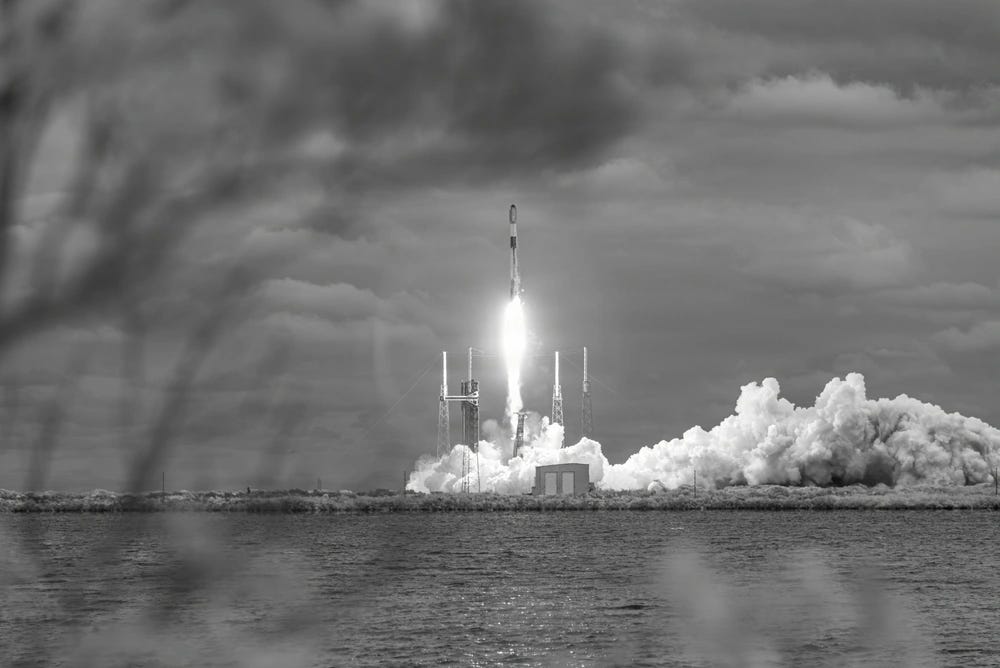
Might I humbly suggest that perhaps we should know how rocket launches and reentry (aka vaporization in the upper atmosphere) impact the environment before we do them thousands of times a year without regulation? And “thousands” is not hyperbole. It is likely an understatement.
First, a brief guide to who does what
Space regulation in the United States is, unsurprisingly, not exactly streamlined. Here are the jobs of each agency, roughly speaking:
FAA / Department of Transportation
Licenses U.S. commercial launches, reentries and commercial launch sites; protects public safety and manages integration into airspace. Environmental review has been part of that licensing process.
Space Force / Department of the Air Force
Operates major federal launch ranges including Cape Canaveral and Vandenberg and conducts environmental review for actions on those federal facilities. FAA may participate as a cooperating agency.
NASA
Operates federal launch facilities including Kennedy and Wallops and has environmental responsibilities for actions on NASA property.
Fish & Wildlife Service / NOAA Fisheries
Consult on impacts to threatened and endangered species, critical habitat, marine mammals and other protected biological resources.
EPA and state environmental agencies
Enforce or administer pollution laws and permits involving water, air, waste and discharges.
So yes: there can be duplication. By all means fix that. Have one agency lead an analysis and the others adopt it. Use programmatic reviews. Stop asking companies to submit the same information six ways. But the FAA describes its goal as “streamlin[ing] the licensing process and reduc[ing] regulatory burden,” and says it is looking for ways to “eliminate or expedite environmental reviews and other obstacles.” Environmental review is not simply an obstacle to getting a rocket off the ground. It is how we find out what happens when we do. Especially given what happens next.
“We apparently know too little about how much commercial spaceflight there will be to agree within anything resembling an order of magnitude. This seems an exceptionally odd moment to decide that we know enough about its environmental consequences to stop asking.”
How many launches are we actually talking about?
The agencies are not internally consistent here, which is worth calling out. When the DOT announced this environmental-waiver proposal on July 28, it cited the FAA’s new aerospace forecast: commercial operations rising from 204 in 2025 to as many as 507 launches and reentries in 2036. When I read those numbers, my eyebrows went up to my hairline, because they don’t track with other sources.
First, there is an important caveat here. That FAA forecast is not all U.S. rocket launches. It covers FAA-authorized commercial launch and reentry operations. Activities carried out by the government do not require an FAA commercial launch license and therefore are not in that total. Fine.
However less than a month later, DOT and FAA announced a new effort to expand American spaceports and launch corridors and said they expect 10,000 FAA-licensed launches and reentries per year by 2035. Not all launches. Not a SpaceX aspiration. Just FAA-licensed launches and reentries. You might notice a difference between the FAA/DOT’s newly stated expectation for 2035 is 10,000 and the FAA’s other stated forecast of 507 by 2036. Those numbers differ by a factor of twenty. You don’t even have to be good at math to see the inconsistency. I have looked for an explanation of how those two figures are reconciled. I cannot find one.
There are other numbers floating around the federal government too. The new National Space Transportation Policy says U.S. ranges must be able to support more than 1,000 launches and reentries every year by 2030. And the Space Force’s Objective Force Design 2040 says it wants the capacity to meet projected demand of more than 3,000 launches per year by 2036.
If you are getting lost in all these numbers, you are not alone. To be fair, these numbers are not directly interchangeable. Some include government launches; some are capacity targets rather than predictions. But that does not rescue the FAA’s own inconsistent numbers, which are definitely not rounding errors. As a teacher myself, I suspect that someone didn’t do their homework, which makes me extra skeptical of everything else that follows if they can’t get the basic math right.
I also feel impelled to add that the DOT/FAA forecast actually reduced its previous high case in part because of “slower Mars colonization.” I confess that Mars colonization is running behind schedule would not be my preferred foundation for deciding how much environmental oversight terrestrial launch activity will require.
The important point is that 500 FAA launches is definitely wrong, and that number underpins the extent of cumulative environmental impact one might predict. And if our plausible futures span hundreds to many thousands of operations every year, that makes cumulative environmental review more important, not less.
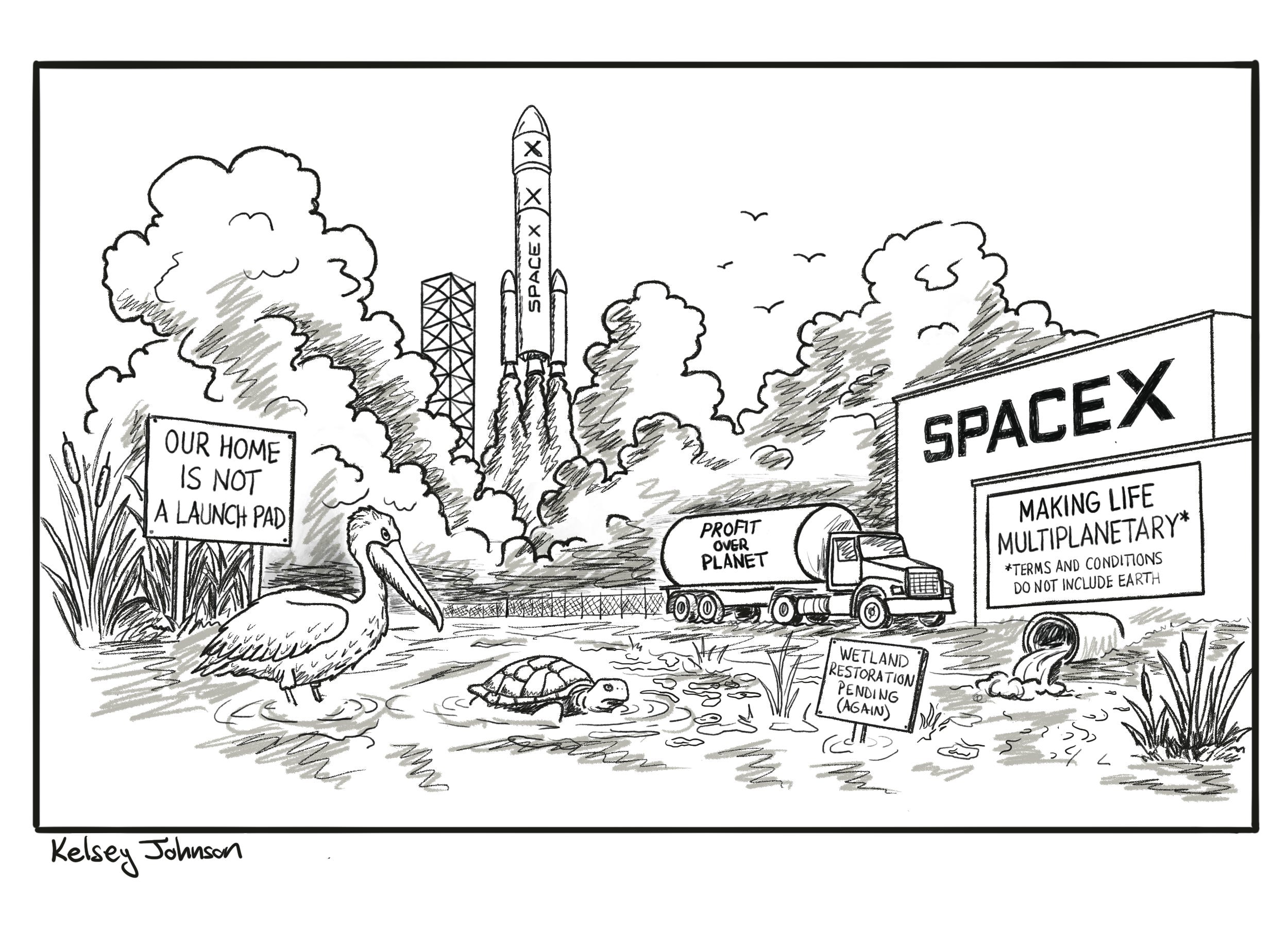
Environmental Impacts of Rocket Launches and Reentry
The environmental impacts are not hypothetical. None of this requires believing that every rocket launch is an environmental calamity, but the cumulative impact is falling between the cracks in government oversight. We already know launches and reentries have environmental effects worth understanding:
Debris, fire, and habitat: Starship’s first integrated flight in April 2023 did considerably more than “damage the launch pad.” According to the federal biological review, the blast ejected concrete, dust, and refractory concrete across roughly 1,000 acres. About 4% of the debris landed outside the area previously analyzed for debris impacts, covering about 20 additional acres. The launch also burned roughly 3.5 acres of upland vegetation within piping-plover critical habitat and proposed red-knot critical habitat. SpaceX subsequently redesigned the pad and installed the steel-plate deluge system intended to keep it from happening again. And debris is not only a launch-pad problem: when launch vehicles fail in flight, the FAA may have to clear aircraft from areas where unplanned debris is falling outside the expected hazard zone. Here is the FAA/USFWS biological review
Water and wetlands: EPA documented seven unauthorized deluge-water discharges into wetlands connected to the Rio Grande between July 2023 and June 2024 (about 262,000 gallons in total) as well as a separate 36,000-gallon liquid-oxygen spill in 2022. EPA classified the deluge water as industrial-process wastewater and found that SpaceX lacked the required discharge permit; each unauthorized discharge was a Clean Water Act violation. SpaceX later applied for a permit, agreed to future sampling and effluent limits, and paid a $148,378 civil penalty. Later water sampling did not find an adverse environmental risk. Which is precisely why regulation matters: first you identify the discharge, then you measure it, set limits, and find out what it is actually doing. Here is the EPA Clean Water Act order.
Wildlife: This is where “Finding of No Significant Impact” deserves a big asterisk. FAA’s own review says launches can temporarily displace wildlife; heat plumes can affect animals and vegetation; launch-related fires have occurred; and a newly identified “gravel plume” extending at least 0.3 miles could damage shorebird eggs. FAA ultimately determined that the expanded operation “may affect and is likely to adversely affect” federally listed species and critical habitat, but concluded that mitigation was necessary. And annual $5,000 contribution to the Gladys Porter Zoo for wildlife-health research. $5,000. Here is the FAA’s increased-cadence environmental finding
And there is a lot of mitigation: The original 2022 Boca Chica review required SpaceX to undertake more than 75 actions before FAA licensing could proceed—including wildlife and vegetation monitoring, restrictions on road and beach closures, advance notice of launch noise and sonic booms, protocols for removing debris from sensitive habitat, and lighting changes to reduce effects on wildlife and the beach. This is worth emphasizing: environmental review did not stop Starship. It changed how Starship was allowed to operate. FAA: more than 75 required mitigation actions
Let’s not forget the atmosphere: Hydrocarbon-fueled rockets put black carbon directly into the stratosphere, where NOAA modeling shows that increased emissions can warm the stratosphere, alter circulation, and deplete ozone. Meanwhile, spacecraft reentry is already measurably changing what is in the stratosphere. NOAA-led researchers found aluminum and other spacecraft-derived metals in about 10% of stratospheric sulfuric-acid particles larger than 120 nanometers; for lithium, aluminum, copper, and lead, the estimated spacecraft contribution already exceeds the natural influx of those metals from cosmic dust. With large satellite constellations, the researchers estimate that as many as half of those particles could eventually contain spacecraft-derived metals. What that does to the stratosphere is not yet known. “Unknown” is not another word for “harmless”. It is also not another word for catastrophic. It means unknown. Which is generally when responsible scientists become rather attached to measuring things. Here are a pair of NOAA reports on rocket soot and ozone and measured spacecraft metals in the stratosphere. That last sentence matters.
There is also some small but revealing text buried in footnote 7 of the FAA’s Boca Chica review. Earlier versions considered environmental-justice impacts. The final analysis says that, following changes in federal policy, that discussion and its supporting data were removed and would play “no role in agency decision-making.” The impacts, of course, did not vanish, only the requirement to consider them did.
Putting this all together, this is exactly the wrong moment to stop looking at environmental impacts of satellite launches and reentry (although I’m not sure there is a “right” moment). Commercial spaceflight is moving from testing toward infrastructure. We are building bigger launch facilities, increasing cadence, launching enormous satellite constellations and deliberately planning for radically more activity.
Meanwhile, the federal government cannot currently tell us whether the relevant future scale is 500 operations a year, 1,000, 3,000 or 10,000. We apparently know too little about how much commercial spaceflight there will be to agree within anything resembling an order of magnitude. This seems an exceptionally odd moment to decide that we know enough about its environmental consequences to stop asking.
Streamline environmental review? Absolutely. Coordinate agencies? Please. Stop assessing environmental impacts because assessment is inconvenient? No. No. No.
If we really are entering an era of thousands of launches a year, we should probably get better at understanding what they do. Not worse.
You have until August 31
The FAA is accepting comments on Docket FAA-2026-8614 through August 31, 2026. The agency explicitly says useful comments should identify a specific part of the proposal, explain the requested change and provide supporting information.
Here are guidelines for submitting effective comments:
Tips for submitting effective comments
Defend Against Deregulation: A How-to-Guide on Writing and Submitting Federal Comments
How you can effectively participate in the regulatory process through public comment
This is an important alarm to sound. All I can hope is that a new administration will deal with this properly. We must hold these companies responsible for the environment.
I can’t find the link to comment. Please highlight it in your text.